Sunday, November 18, 2012

I'm no Cinderella but I think I see a pattern here...

http://www.nytimes.com/2012/11/18/opinion/sunday/throw-out-the-rules-and-read-the-grimm-tales.html?ref=editorials


            One part book recommendation, one part reminiscence, and one part philosophic musings, Verlyn Klinkenborg’s article Throw Out the Rules! Read a Fairy Tale manages to avoid the inconsistency that would normally come with trying to do so much by being inconsistent on purpose. With jovial nods to other pieces of literature, fanciful figurative language, and a penchant for alliteration, Klinkenborg creates a light and enjoyable piece that perfectly suits the fairytales that he himself is discussing.
            Even in the opening paragraph, he comments on the seeming abilities of an enchanted prince, stating “This is not a truth universally acknowledged in our humdrum world” which is a paraphrased version of the opening line of Pride and Prejudice. In the next sentence, he’s left the Victorian era behind and is comparing the foreshadowing of the tale to that of Sophocles. Most notably, he directly contradicts himself while simultaneously referencing a contemporary author. He mentions that “It feels at times as though all these imaginative worlds will someday converge…” and in the next sentence insists that “Someday? Terry Pratchett has already done it.” Even in less specific references, Tolstoy, George R.R. Martin, Kierkegaard, and J.K. Rowling are all welcome comparisons drawn in this article. These references hop unperturbed around the literary time stream, detaching the article from any sense of severity or regulation, and giving it a whimsical sense that only a piece on fairy tales could excuse.
            Klinkenborg also uses similes to his advantage, crafting them carefully to suit the subject matter at hand. For example, rather than reading the fairy tales, he will have “absorbed them from the air around [him], where they abide like a haunting cultural mist.” The diction even within the simile is appropriate to the vague realm of fairy tales, with ‘haunting mists’ obscuring truth and setting the atmosphere. Also fitting with the fairy tale theme, some of his comparisons are far more whimsical, comparing fairy tale rules to “embroidered samplers you might find hanging in a witch’s kitchen.” Not only topical, but delightfully childish to consider. Even the feelings evoked by these expressions differ completely- one giving a sense of foreboding and one a chuckle, and again this perfectly emulates a fairy tale.
            Most notably, Klinkenborg uses heavy alliteration to keep his work playful and fresh. In discussing the prevalence of fantasy, Klinkenborg notes that “The Tolkein-tide shows no signs of subsiding, and if your taste runs to dragons, darkness and derring-do...” which alliterates Tolkien’s ‘t,’ the ‘s’ of signs, and the darting consonance of ‘dragons’ and so forth. This musical quality that he gives this phrase allows a narrative weight to settle on his own article. When discussing the original Grimm tales and the laws that govern them, he says that they “veer vertiginously,” using not only colorful alliteration but a choice of diction that perfectly encompasses both the Grimm tales and his own work- a dizzying switch between ideas and mood that still creates an enjoyable whole.
            This article shows a genuine sense of humor and a true thoughtful creativity that makes it almost as much a joy to read as the fairy tales it recommend. As a sales piece both for Phillip Pullman’s rewrite and the Grimm brothers’ original tale, it is effective and invaluable. By creatively weaving in narrative techniques usually reserved for the media he is recommending, he creates a sense of harmony in the world, along with a desire to whip out he nearest copy of Cinderella. 


Sunday, November 11, 2012

My Type is Byronic, Can You Tell?


1979. Choose a complex and important character in a novel or a play of recognized literary merit who might on the basis of the character's actions alone be considered evil or immoral. In a well-organized essay, explain both how and why the full presentation of the character in the work makes us react more sympathetically than we otherwise might. Avoid plot summary.

            He lies. He coerced a young girl into becoming his bride, with a wife still living. He manipulates this girl, making her jealous by pretending to love another. He’s the only man this girl has ever known personally. He treats those that displease him with uniform scorn, he lived a life of debauchery for several years, and he has mood swings. Yet, because we see him through the eyes of a woman who loves him with all her heart, we cannot despise Mr. Rochester from Charlotte Bronte’s Jane Eyre.
            By all rights, Rochester should be the villain of the tale. He seduces and coerces Jane into marrying him, ruining the stability of her life in the process. With that detail alone, he is a vicious debaucher. However, with Jane as a narrator, the reader gains a new perspective. Having Jane’s story from the beginning as a timid young girl, the positive changes that Mr. Rochester brings onto Jane are apparent. Even before their love is found to be mutual, Jane’s spirits heighten. She laughs more, is freer to speak, and no longer feels trapped as she was before at Lowood and Thornfield. Once they become engaged, Jane blooms. Rochester’s positive affects on Jane endear him to the audience.
            Jane is also very open with Rochester’s faults from the beginning. Even on their first meeting, when they were strangers in a lane, she noted his brusque nature. Rochester, for his part, is also frank with his faults to Jane. He tells her he has not lived as purely as he would have liked. This small honesty, despite how much it conceals, is still enough for him to earn a reader’s trust. Beyond even his admissions, though, Jane is perceptive enough to see that there is a dark secret somewhere in his past. She knows about Celine Varens, even, and yet as a narrator she only expresses the desire to delve deeper into Rochester’s past. She makes him appear desirable through her own desire. In Jane’s eyes, even his faults and foibles are mere ‘seasonings’ that make him more appealing.
            All of the hinting and secrets lead up to the large reveal of Bertha mason at Jane’s would-be wedding, and Rochester tells Jane his story, from his marriage to his meeting of her. By then, the reader has felt Jane’s grieving, and is emotionally connected to her, so Jane’s pain for Rochester’s past also carries over. Jane doesn’t blame or fault him so neither does the audience. Rather than anger at a treacherous man, Jane creates a picture of desolation – two people with the world against them, which invites sympathy for both rather than ire for one.
            The most obvious reason for this is, of course, that Rochester is Jane’s soul mate, and a romance doesn’t work if one half of the couple is despicable. However, the sympathetic portrayal given to Rochester also represents the shedding of traditional dealings with those who do wrong. If Jane, with her ethics carved into her heart, can forgive this sinning deceitful man, can still love him entirely, then why should anyone else not be able to? Jane Eyre is a character with the ability to love the sinner and hate the sin, the same doctrine that Helen Burns gave her so long ago. Being put in her shoes invites sympathy for sinners as a whole. Rochester isn’t inherently evil to Jane, he is a man that circumstances have worked against. Jane Eyre casts sinners as victims, which challenges the entire morality of the time period.
            Of course, Jane Eyre is first and foremost a love story, but it is also a cry for acceptance, change, and for people to remember what true goodness really is. Jane herself is the perfect example, loving Rochester for all his flaws. Bronte begs for a more forgiving society in her novel, and redefines love to allow for it.
            

Sunday, November 4, 2012

Response to Course Materials 3- The Reckoning

Going by the state of my notes, a lot of these past couple of weeks has been a lot of talking.

I have to say, though, the in-class discussions we had over The American Dream were some of the best I've had in my entire life. Nothing is worse than a discussion that is more awkward silence than it is talking, and nothing is better than one where everyone chips in a bit. I always find that it's easier to figure out what the heck an author is talking about if you can bounce ideas off of people, and it's nice to have so many people to bounce ideas off of. Truthfully, we came to some mind blowing conclusions (The leaking johnny is their dead kid! Mommy's hitting on her adopted son! Daddy doesn't realize Mrs. Barker exists! &c). I'm still reeling. I'm still not sure, though, that I would call The American Dream a comedy, though. It might have comic elements, but they're not trying to make anyone laugh.

Then we did a lot with the "objective" half of the AP test, as opposed to the essaying half. I can't say that they're any easier for me than an essay will be. Sure, the essay prompts might be completely impenetrable and layered with triple meanings, but subjective tone questions and pick definitions, it seems, will always come back to bite me in the butt. Looking at how the test is scored, however, was a bit of a relief. Regardless of the few questions I consistently get wrong, with a good enough essay grade, I can still safely get a 4 or a 5. Writing our own questions was a bit of an experience--as hard as it is to answer someone else's bizarrely crafted question, trying to come up with one yourself that still has a clear answer about a poem that (while it was incredibly good) you aren't entirely clear on, is just as hard, if not worse. I can't even blame the other group for getting questions wrong, because our group didn't even agree on the answer that we should make correct.

I still disagree with the sheer existence of an objective literary test, but at least now I can sympathize a little with the poor jerks who have to write the questions for it.

Death of a Salesman came next, and then I went to Stratford, and then I stayed home a day, and then I saw the end. It made discussion on Wednesday just a little bit difficult. Somehow, I ended up with the impression that Willy had sold his soul to Ben, and died to give his family what he thought they needed. I watched the movie on Thursday, and, to tell the truth, I really disliked it. I've read Arthur Miller before, and I've seen two different versions of The Crucible. I love The Crucible. I love John Proctor and I love Abigail and Mary and I love the story and I love how angry it makes me. I don't understand how the same man could write such diametrically different sets of characters. What makes The Crucible for me are the characters, and how real they feel. Death of a Salesman is totally lacking in that. I don't like anyone in it, and I don't think they have any redeeming qualities. There are a few things in them that pull out bits of sympathy, but I also think that most of the suffering they all go through was brought about by their own hands, so I can't feel anything but disdain and a vague pity. To be fair, this is my opinion before we discuss it in class. Maybe I'll discover hidden depths to Biff or to Willy or to someone that will make me appreciate their character, but as-is, no one in the play has redeemed themselves.

Interestingly enough, this play is going to be harder to analyze, I think, than The American Dream. While none of the dialogue of American Dream makes sense in and of itself, it's much easier to sense narrative patterns when one doesn't have to consider what the playwright is doing to make their characters believable. Absurdism might look difficult from afar, but really what it does is strip down a piece to its basic components, without believability getting in the way. Death of a Salesman, on the other hand, is not only trying to prove points and be literary, but to create a family and characters and a world that audience members feel is real and genuine. Now, personally, I don't think it does a terribly good job of it, but it's still trying, which adds a whole new layer to any given analysis.

Wednesday, October 24, 2012

The American Dream! Damn it!

Summary:
The American Dream is a play of character introductions. It begins with Mommy and Daddy discussing banalities in their average looking living room and waiting for the arrival of a mysterious 'they'. Mommy gets sidetracked in a story about materialism, and then Grandma appears, carting a large number of mysterious boxes. Grandma rants about the state of the world, about being old, and about Mommy when she was young. Then there is a knock at the door, and who should it be but Mrs. Barker, the 'they' (yes, plural) that Mommy and Daddy were awaiting. However, none of the three of them know exactly what Mrs. Barker is meant to do there. Grandma knows, but she is constantly being interrupted and corrected- or misunderstood in the case of Mrs. Barker who was not working at anywhere 'very much like' an adoption agency. It isn't until the final character introduction, to the American Dream himself (otherwise known as the Young Man) that the backstory shapes itself completely, the conflict is discovered, and the conflict is resolved. Long ago, Mommy and Daddy adopted one of a pair of twins, and mutilated it because of its natural urges. Now, the other twin appears, physically perfect but bereft of all human emotion- the perfect child that Mommy and Daddy tried to create. Grandma, even as she departs, arranges everything so that everyone else is satisfied. At least, they think they are.

Style:
Albee uses absurdism to get his point across in this particular play, with massive circular conversations, an even larger narrative circle, meaninglessness of dialogue. No one knows or cares what anyone else is saying as long as the tone is right, and Mommy is particularly guilty of shifting topics each time the conversation threatens to get too emotional. The play as a whole, however, cannot be absurdist, because by definition absurdist plays have no message or meaning. Albee clearly communicates his ideas on the consumerism, materialism, and 'deformity' (conformity) of the 50's and 60's, marrying the best of both the absurdist and more traditional worlds of screenplays.

The key to unlocking this particular play seems to be repetition. Sometimes dialogue will be carried over from pages ago, only to be brought back again. This doesn't just emphasize the absurdist format of the play, but it draws attention to the dialogue itself. Why does Mrs. Barker's cream hat come back, after it was beige when Mommy bought it, and wheat on the street outside? To remind the reader about the two women's relationship with each other. Why does Mommy directly contradict one of her earlier statements ('you can't get satisfaction') with 'Who says you can't get satisfaction?' at the end? To remind the reader what the play is about- the quest for satisfaction and the meaninglessness that follows it wherever it may go. Why do Grandma's perfectly wrapped boxes keep coming up? To remind the reader of Grandma's character- her boxes were always full, despite what everyone thought due to their exterior.

Grandma's character is the most sympathetic to audiences, and one of the subplots of The American Dream is her departure from the apartment/her death. She starts out by packing, taking every memory she can manage, then declares The American Dream to be the 'van man' to take her away. Once she has left the apartment and at least metaphorically died, she closes the play by shattering the fourth wall into a thousand pieces, saying that "that just about wraps it up" (emphasis mine, because I just realized that this connects to the boxes that Grandma also wraps so prettily).

Albee emphasizes the points he makes by creating a very shallow work. Giving Mommy the flibbertigibbet about 45% of the lines, he ensures that the dialogue will be stuttering, stilted, and emotionally detached. Mommy bickers with Daddy, with Grandma, with Mrs. Barker, without any real ire, she cries without real pain, and she's more than eager to distract herself from anything that would give her any depth of emotion. Even when Mommy is absent, the dialogue is as hollow as the characters themselves are meant to seem, except, of course, for the Young Man. Ironically enough, the character who professes himself unable to feel give the most poignant speech in the show as he talks to Grandma and describes the emotional aspects of Mommy and Daddy's mutilation of his twin. This puts the Young Man at the emotional center of the play, with no one else coming close to his level of participation and sympathy. Even Grandma is a caricature in comparison. With this contrast of character, between the Young Man and everyone else, Albee creates a much more effective picture than vapidity would have alone, because the Young Man is clearly desperate to feel, and surrounded by people who are quite the opposite.

Theme:

  • Edward Albee's play The American Dream discusses the cheapening of ideals as they are passed down through generations. 
Grandma is the oldest person in this play. Mommy, Daddy, and Mrs. Barker are all of the next generation, and the Young Man and his deceased twin make up the third. The thing to consider here is the whole story surrounding Grandma's boxes. First, we see Grandma carrying them all downstairs in the present time, but then we are sent back to Grandma's heyday when Mommy was a child. They were poor, and Grandma would pack beautiful lunch boxes, that were full of good food. Mommy would pretend they were empty, refuse to open them, and eat everyone else's lunch, and Grandma would get the food back. Despite the fact that the boxes were full, the reader fully expects them to be empty, and so does Daddy. A full box, that is beautifully wrapped, implies something that is just as substantial as it is lovely. The box that Daddy expects is all form and no function. The same idea of functionless form is carried over into the Young Man, an attractive man, who cannot love or feel- and ends up being ideal for Mommy and Daddy.

The middling generation, however, is not as adept at existing as empty boxes, however. Mrs. Barker succeeds the most at this particular goal, becoming a 'they' in her quest to do everything and become the perfect person. She so has many faces, from a 'professional woman' to bring them satisfaction in the dirty sense, to the chairman of the women's club and a respectable upper-class lady, that none of them really suit and she becomes a wall of different personas, with nothing of substance to support her own personality. Mommy and Daddy, however, can't manage such a feat. They try, certainly. Mommy never keeps her mind in one place for long, but the sheer fact that she needs to change the subject so often implies that there are feelings of discomfort beneath it all. She even cries when she discovers Grandma is gone. Daddy, of course, has been demasculated and is considered useless except for his money by Mommy. He attempts, though, to convey his misgivings about things, or his dislike of a course of events, which gives him an opinion and a character, weak as they may be. His thoughts are easily swept out of the way of Mommy's rants and schemes. 

Quotes:
  1. Grandma: "The American Dream! The American Dream, damn it!"
    • This quote makes more sense out of context than it does inside it, truthfully. Grandma hollers this to Mommy when Mommy asks who is in the apartment with Grandma. It is a true statement, but it is also a nuanced one. It expresses immeasurable frustration with the idea of the American Dream, 'damning' it, obviously, but it also indicates Grandma's personal feelings towards her situation as a whole. She knows that this American Dream is going to replace her, and even with the sympathy she feels for him, she can't help but be distraught at her own predicament.
  2. Grandma: "Well for the last straw, it finally up and died; and you can imagine how that made them feel, their having paid for it and all."
    • This expresses not only the cry against commodification that echoes through the play, but reemphasizes several characteristics of the narration as a whole. The baby's death and Mommy and Daddy's feeling, whatever it may have been, about it is expressed in financial terms. They paid for it, they must mourn its absence because of the investment that it represented. It's also a continuation of the pattern of announcing feelings, rather than expressing them indirectly. We aren't even told how it makes them feel, just that it made them feel something, presumably unpleasant. Aside from the mutilation of a child discussed directly before this quote, it dehumanizes Mommy and Daddy to describe them this way.
  3. Daddy: "Because it was empty." Mommy: "Oh no. Grandma always filled it up; because she never ate the dinner she cooked the night before. . ."
    • I've mentioned the relevance of this before, but Grandma's boxes are always full. Grandma always provides, even when she must do without, and this quote shows that even though they fight constantly now, Grandma and Mommy looked after each other in the past, and had a very close mother/daughter relationship. Grandma went without food at night, but Mommy always made sure to bring it back. It adds complexity to a relationship that is otherwise based off of only mutual disdain. It also showcases the materialistic natures of Mommy and Daddy, as well as the pessimism inherent in their generation, since Daddy expects the box to be empty. 

Sunday, October 21, 2012

On the Corner of Snark St. and Science Boulevard

Madness ensues:

The G.O.P.'s Feminine Mystique 
Article here!


            Samantha Bee is a correspondent for The Daily Show, a liberal-leaning show on Comedy Central that dissects and mocks the mainstream media. However, in her article The G.O.P.’s Feminine Mystique, she shows no particular ire for the G.O.P. itself. Instead, she uses a clever blend of nonsensical asides, a disdainful tone, and a blend of snark with honest and clear criticisms to highlight the faults of a study performed by U.C.L.A grad students.
            The study, as she says, “determined that the women of the Grand Old Party have more feminine faces than those of their female Democratic colleagues” by way of random images first rated for their femininity, and then presented to college students who determined the political party of each face. Faces that were more typically feminine were rated to be more conservative.
            Bee’s reaction to this study is as hilarious as it is opinionated. She begins her entire article with two leading questions- “Did you know that science can teach you all sorts of amazing things about how the world works…” and “Did you know that it can also teach you things you never wanted to know and now not-so-secretly wish you didn’t?” Right off the bat, her opinion is made clear; that science can do incredible things, but that incredible can have two separate meanings. Following her explanation of the study, she mentions the name for the effect (“the ‘Michele Bachmann Effect’”) and proceeds to go on a long-winded tirade, ending in her living in “monkish isolation on a mountaintop,” about how she feels when hearing ridiculous things. This exaggeration, given in such close proximity to a conclusion from the study itself, heavily implies that the study itself is one of those selfsame ridiculous things. Her far more interesting aside, however, directly insults the scientific integrity of the study. She describes her own haphazard shoe counting at the Democratic National Convention as “the type of research done after three days of being yelled at…with only a steady diet of Coke Zero and SunChips to keep you upright.” By all rights, the U.C.L.A. study which “contains measurable scientific data collected by actual professional scientists” that she describes should have markedly different results than her own foray- but it doesn’t.
            With that critique of U.C.L.A.’s scientific integrity squarely tucked away, Bee takes on the tone of a much smarter, more worldly mentor despairing at the banality of the world at large, and the study in particular. In her second paragraph, as she explains the purpose and method, she not only expresses a disdain for the G.O.P. by spelling out “Grand Old Party,” but she chooses to add that the undergraduates who were selecting the faces were doing so “in exchange for course credit.” This casts a very greedy, banal mindset over the whole study, and implies that it wasn’t carried out half-heartedly for personal gain, rather than objectively. She also uses several well-known platitudes, saying first that “if the sensible shoe fits…” and mentioning that the scientists behind it have “basically given us the green light to go ahead and judge a book by its cover.” This is the essence of her complaint, but it also hints that the conclusions that could be reached by the data are childish and basic- much like the statement itself. Her superior tone only continues at the end of the paragraph, asking “…why would that stop anyone from conflating gender typicality with sex appeal?” and answering her own question with “The answer is ha ha, of course it wouldn’t, but I adore your innocence.” She is talking down, of course, but she does it in a way that doesn’t feel condescending to the reader in particular.
            Her most effective technique is the juxtaposition she offers between her comedic statements and her legitimate criticisms. One always follows another, and the contrast is often more effective than either would have been on their own. The whole piece takes on a structure of joke-criticism-joke-criticism. For example, she goes into a serious discussion of how the study suggests that a key factor in the “presence of a female politician on a national stage can be dependent on something as random as the placement of her eyebrows?” is immediately followed by the idea that the whole study is so “unforgivably retro” that “…once I finished reading the study I’m pretty sure 1970s Burt Reynolds reached across the passenger seat of his Trans Am to give me a wink and a boob honk.” She puts her worries about political objectification of a woman’s attractiveness in direct and honest comparison to an impossible comedic scenario- and in doing so, insinuates that the two aren’t as different as they initially appear. This structuring of her piece also manages to hide her working thesis for five paragraphs, but it does not diminish its effectiveness. The reader is forced to think through the entire opening scenarios she presents, and extrapolate her final argument. It keeps the editorial engaging, because the path she leads the reader on is clear enough to follow, but twisted enough so that her conclusions are at least a new thought in the series.
            In her article, Samatha Bee does what she is paid to do on The Daily Show- point out the flaws in something in a comedic way. It is her ability to sneak up on a reader with her point that makes her article unique. 

Sunday, October 14, 2012

B-b-b-bird Bird Bird, Bird is the Word


1984. Select a line or so of poetry, or a moment or scene in a novel, epic poem, or play that you find especially memorable. Write an essay in which you identify the line or the passage, explain its relationship to the work in which it is found, and analyze the reasons for its effectiveness.


            Speaking from experience, it is incredibly easy to forget things. Names, faces, birthdays, mathematical formulas, atomic numbers, phone numbers, and appointment times are all things that slip through the cracks in the human mind. It is far more interesting to consider what makes things stick, and how people remember things. In general, for something to be memorable, it needs to hold emotional weight or personal relevance. The brain doesn’t hold on to details it finds unimportant, no matter how much easier life would be. Storage space is limited, so when a line from a work sticks in deeply, it must be highly relevant. Shakespeare’s Romeo and Juliet has worked its way into the memory of Western culture, but the lines exchanged between the two lovers as Romeo departs after wooing Juliet on her balcony are especially memorable because they serve not only to characterize the pair, but also to heavily foreshadow their fate.
            The average person could probably recite ‘parting is such sweet sorrow…’ but in this case, the lines directly preceding it are far more interesting:
ROMEO: I would I were thy bird
JULIET:             Sweet, so would I.
Yet I should kill thee with much cherishing.
They are exchanged at an emotionally weighted moment. Juliet and Romeo have just declared their love for each other, and as Juliet is constantly interrupted and fluttering back and forth, their farewell is extended for quite some time. The audience softens to the lovers as they exchange passionate words of love and devotion, but these words also do much to establish their eventual doom, as well as the reasons that doom is inevitable.
            First and foremost, the phrase ‘kill thee with much cherishing’ is a massive clue that everything will not go smoothly for our star-crossed lovers. It is grim language for a thirteen year old girl, and highly introspective at that. Having just agreed to marry him, Juliet suddenly expresses fear that she would love him so much, as a spoiled child loves its pet bird, that she would kill him because of it. They are also her parting words to him- a warning- that he should not trust her, or that her emotions will come to be too strong. Romeo answers, to nobody, a wish for her to sleep and be at peace, which is eerily reminiscent of his own ultimate fate when Juliet’s fake sleep takes on the appearance of death (or, eternal peace) and leads him to his death so as to join her in it- another sentiment expressed in this grim farewell.
            Romeo’s tendency to variance and mood swings has already been established by the time this scene arrives, but this scene is still an instrumental indicator that he is far too headstrong for his own good. Having met and kissed Juliet once previously, he sneaks in to his enemy’s territory, and proposes to marry her, professing his undying love. However, the fashion in which he does it says much about who he is- for example, swearing his love on the moon, which (as Juliet is quick to point out) is ever changing, and often used as an excuse for reckless and crazy behavior. He also shows a slavish devotion to Juliet, throwing himself totally at her feet, notably expressed by his wish to be her pet bird, completely on her string and ruled by her entirely. The balcony scene paints Romeo for what he is- a young boy who is completely ruled by his emotions. He is ruled not only by his own whims, but by those of his lady-love, coming at her call and vowing to stay until she dismisses him.
            Juliet, for her part, is established as the more practical one, demanding that Romeo ‘swear not by the moon’ and worrying that she will seem too forward and he will loose his interest in her because she will not play games with him. She is also the one, in the end, to suggest he marry her if his love is true and faithful- ensuring her own security. Sadly, she falls to Romeo’s charms and turns to his whimsy, her initial fears of everything being too sudden transforming into a proposal of marriage and the same silver tongued adulation that Romeo uses so often. Juliet’s practicality could partially be explained by the location of this exchange. If she is caught with a man in her room, with her at night unchaperoned, the consequences for her would be devastating. While Romeo is unbothered by the risk, Juliet does much of the concealing, and more worrying than Romeo ever had. It is she, after all, who delivers the death stroke of foreshadowing “I should kill thee with much cherishing.” With that line alone, she reveals her own introspective abilities, and a clearer eye to the future than Romeo.
            Of course, from the beginning of the narrator’s introduction to ‘fair Verona’ the audience knows the fate of Romeo and Juliet, but there are still clues sprinkled throughout the play that the pair is doomed. Without those intermittent hints, the play would not have survived as a piece of literature, because it would have bored audiences to tears. A fated death is tragic, but one in which the reasons are evident is also interesting and memorable. While Shakespeare could have left all of the explanation and subtle reasoning out of his play, and attributed it all to fate, he was wise enough to see that clever characterization and beautiful language would also be necessary to make not only the balcony scene, but Romeo and Juliet as a whole, worthy of remembrance. 

Sunday, October 7, 2012

Course Materials 2- Electric Bogaloo

A lot of what I remember from the days after the last course materials response is a blur of handouts that were frantically annotated and bickered over. I'm not sure mine were even legible, but I constantly found myself moving out of DIDLS and instead going towards conclusions, or I'd find something notable that I wasn't sure where to place. Where did alliteration go, exactly, or the other poetic devices in the DIDLS frame? How about color symbolism- details, maybe? DIDLS themselves are clear enough, but there are things that work beyond and outside the frame of diction-imagery-details-language-syntax that I'm not sure what to do with. I know they're relevant and I have comments to make on them. Regardless of that particular headache, I found myself with fascinating insights into different works. Two of them I had read and one that I haven't but now want to. I know for a fact that, had I not tried to purge my mind of past influences, I never would have thought that Alice was dying as she fell down the tunnel, but think about it. "Light at the end of the tunnel" sound familiar? I found that dialogue was harder to pull apart than narration, because it's too easy to imagine it simply as part of a character or as a forwarder of the action and completely gloss over it, which made Little Women patently difficult. It was unfortunate, though, that I missed the day we covered syntax, because I have a feeling it would have been difficult for me anyways. On the long, long list of things I don't pay attention to when I read, sentence structure is right at the top, and I have no reference for what it means to a work that it is 'subject verb object' or vice versa or some oddball combination of the three. I suppose I'll just have to feel it through based on what feels odd or noticeable. In general, if I could just read text excerpts and bicker about their meaning for the rest of the year, I'd be completely happy.

Then, at least according to my notes, we moved on to literary theory, which I found absolutely fascinating because I am a geek. By and large I walked out of it with a bit of a crush on Aristotle, and from there it was largely a rehash of things we'd gone over in Brit Lit previously, and AP World before that (at least with regards to the Dark Ages, Renaissance  and the age of reason (although we didn't go very far into that)). I hope I wont' be called upon to name specific authors from each period, though, because boy howdy are there a lot of them. I can pick out the notable ones, ranging from Beowulf's nameless author to Dante to Shakespeare to Blake and on and on and on. Funnily enough, the stuff about the earliest theory (Plato) and the newest postmodern stuff was really the only new information. None of my lit classes previously ever talked about a simulacrum idea of the world, or about Plato's cave, which I found fascinating, if a little harsh to authors. Thus, the crush on Aristotle. I found myself agreeing with a lot of Postmodernist thought, which is hardly surprising, considering we're living within it- although I am skeptical of a generation's ability to name the period they're living in. Let my great-great-grandkids decide whether postmodernism even exists; history written as it happens is hardly accurate and unbiased.

Critical lenses, by and large, were a review. Since I took both Am Lit and Brit Lit, I had already been drilled into the ideas, although I can definitely say that this particular mode of information transport was definitely new, but not necessarily in a bad way. Seeing the lenses actually applied to the same subject (even if it was just a urinal) was very helpful in comparing them and seeing what the real differences were between them. The two new ones were very closely related- postcolonial and Literary Darwinism. Thank god for last minute crash courses, because I had Literary Darwinism totally backwards from what it actually is- rather than the culture with the strongest literature being the ones remembered, I thought it was the dominant culture's affect on the literature- which is actually postcolonialism! Confusing stuff! I think it would have been better to go over these in class, but I understand that time was of the essence.

Speaking of massive time-sinks, the allusions presentations were absolutely bafflingly long. Luckily, they were all engaging. As a child, I had a big yellow book of greek myths that I read until the cover fell off, so a lot of the stories were review- but a lot of them weren't. And yes, sometimes it hurt me to have things confused or fumbled or mixed up, but I learned a lot of stories that I hadn't had the full background to- especially the backstory to the Trojan War. Who knew it all started because of a cranky goddess? That's what I truly love about Greek myths- there's an overarching story of a war in Troy, but there are a million other stories that all happen concurrently. Odysseus  Philoctetes, Circe, all work within that story, but they each have a story of their own. Greek myths are an immense stretching entity that weaves itself over history so cleverly that I can't help but appreciate it. The Bible had a lot more new territory- although more of it was familiar than I thought originally. Also, please please please know that the people of God are the IsraelITES not the IsraelIS. One is correct now, one is correct biblically. I know that giving my presentation was fun, although I always forget how nervewracking presentations are until I'm up there and no one is giving any feedback because everyone is taking notes at the speed of sound.

I have to admit to being that guilty good kid who dishonored her family when we didn't have enough copies of The American Dream to start reading on time. I also have to admit to kind of loathing the beginning, as I suspected I would dislike the Theater of the Absurd when we read the article about it claiming that previous literary movements had somehow had aspects of the Absurd as opposed to the other way around. All that aside, the first part of it is awkward to read through, seemingly empty, and essentially perfectly in keeping with the style of Theater of the Absurd. It was only after we moved on from that, as the article we read afterwards suggested, that the play got really good. While I'd contest him on Mommy being 'eager to get rid of grandma' or 'vicious and emptyheaded' (at least, not entirely) the author of the article had a lot of solid, salient points- most of which I had already picked up on, at least in part. What I'm wondering now, and what I was wondering as I read it, is what other meanings are to be found beyond the obvious and apparent. That's always where the real analytical gold is; hiding behind the overarching obvious point. There are subtle little things hiding in there, and I hope we get to them in class, because otherwise we're doing ourselves an intellectual disservice.

Sunday, September 23, 2012

Getting so Meta That it Hurts

How To Not Write Comics Criticism: http://www.dylanmeconis.com/how-not-to-write-comics-criticism/


Dylan Meconis’ article How Not to Write Comics Criticism is a plea to reviewers to treat comic books with the same respect they would give novels or movies. To do so effectively, he takes an angle that simultaneously welcomes the uneducated and rags on the willfully disdainful; helping the clueless along the road while pointing out everything that they should not become on their journey.

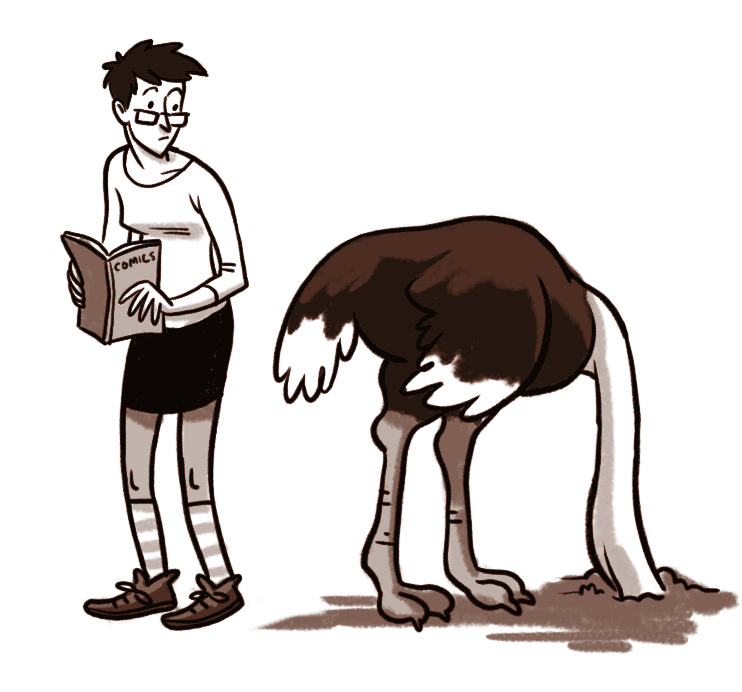
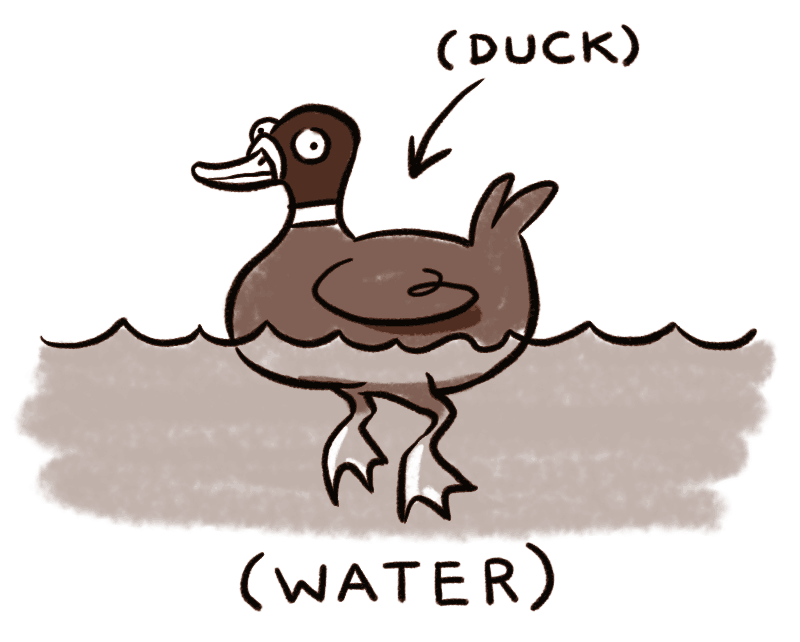
Probably his most striking tactic, Meconis uses imagery and figurative language in one fell swoop, scattering images around his article that bring to mind common and every day sayings. Nothing could be more fitting, considering the fact that his article is a discussion on comics themselves. Often the drawings are captionless, but frequently they draw obvious parallels between what he was just discussing and what is being illustrated. For instance, this image:
 follows up a discussion on people who resent having to read and review comics, and dislike them off the bat simply because of the media they represent. The picture, without saying anything directly, immediately points the reader’s mind towards the saying ‘to stick one’s head in the sand’ Another example of a visual metaphor he uses is this:
  when talking about an artist’s seeming choice to make a comic rather than a more traditional form of art. Again, nothing is directly stated, but the obvious connotation is the phrase ‘like a duck to water.’

His logical leaps aren’t limited to images though. Often, he will take a statement to its logical extreme solely to point out how ridiculous it really is. Under list item 3, explaining why movie successes aren’t related to comic popularity, he asks if a reviewer would start with “’With the box-office success of Twilight, novels have proven their appeal to a wide audience’?” The title for number seven is a jump in itself that doesn’t make sense until you read what follows, saying that “This muffin is so good that it’s actually a bagel” to poke fun at those who are terrified of calling a comic ‘good’ and must elevate it to some type of hybridized novel status.

Regardless of the technique he uses, he is constantly comparing poor reviewers and close-minded people as being unprofessional and illogical in the techniques they use. Without ever having to overtly say ‘you are being an idiot for doing this,’ Meconis manages to convey it. He never says ‘people who do this are stupid,’ he says ‘doing this is stupid, and this is why.’ It is an excellent tactic, when the purpose of his article is considered, because it doesn’t directly make an attack on anyone for doing what they do. Instead, it attacks what has been done, which is something that hopefully, no one will take as a personal criticism. Even with his informal tone and his use of witty comics, Meconis keeps his work at a professional level by refusing to directly attack anyone.

Meconis also addresses this fear of the word ‘comic’ very explicitly, and in doing so puts a great emphasis on diction and its importance. He takes an entire section to define ‘comic’ along with the difference between a comic book and a graphic novel (which he describes as barely relevant) but also takes a moment to ponder the denotations of some terms that cycle the comics world. Going all the way back to novel, which he mentions once connoted “’sordid fad that is corrupting our women and children’” as well as the fact that graphic can also mean violent and adult material. He has fun with ‘graphic memoir’ as well as a non fiction graphic novel, because “novel implies fiction” so a non fiction graphic novel ends up meaning “book length work of non fiction comics fiction.” While Meconis allows for the fact that there is no true set of terms, he expresses a wish “to hear ‘comics’ replace ‘graphic’ and thus hear about a ‘comics novel.’” In another section, he goes out of his way to define terms referring to the construction of comics themselves, like ‘word balloons,’ ‘panels,’ and ‘gutters.’
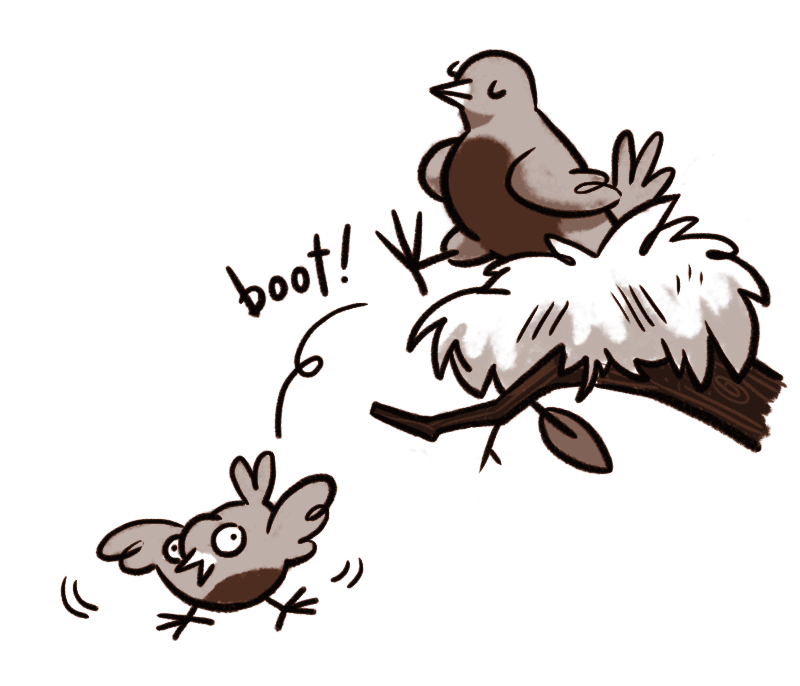
Also in that section (#6) he expresses the idea that reviewers should assume that readers are “capable of looking up terms they don’t recognize” having already explained terms that we, the readers, weren’t expected to know. While this may seem insulting, when put together, it really only serves to highlight his purpose- to educate comics reviewers and show them how to do things in a way that doesn’t insult the genre they’re reviewing.  Meconis starts out by inviting the uninitiated, teaches them the basics, and then, with his final visual metaphor,
 
he sends them on their way.


Sunday, September 16, 2012

It Builds Character


1980. A recurring theme in literature is the classic war between a passion and responsibility. For instance, a personal cause, a love, a desire for revenge, a determination to redress a wrong, or some other emotion or drive may conflict with moral duty. Choose a literary work in which a character confronts the demands of a private passion that conflicts with his or her responsibilities. In a well-written essay show clearly the nature of the conflict, its effects upon the character, and its significance to the work.


            Living in sin is an outdated concept to those of us living in the present, but back in the days of corsets and feathered bonnets, the idea of living as man and wife without being actually married was shocking to say the least. To a young girl raised from birth to be devoted to the Christian faith and doctrine, the very idea would be synonymous with degradation and an assurance of hell in the afterlife. To a young girl hearing this proposal from a broken man who needs her, and the one man she’s ever been close to, the idea is far more tempting. This very scenario, the choice to throw her principles away or cling to them and suffer, is presented to Jane Eyre on the very day she was meant to be married to the same man, and the choice she makes defines her character and sets the moral tone of the novel that shares her name.
            Jane was taught at Lowood, a charitable school for orphans comparable in its rules to a nunnery, from the age of ten to sixteen. In her first year there, she met everyone who would come to shape her mind from then on, most notably a girl called Helen Burns. From Helen, she learned much of Christian morality that escaped her childish mind. Doubtless, more of her religious morals sprung from Helen than from the mandatory church service the girls attended and the scrimping man who ran the institution strictly on the principle of debasement. Helen, a soft, gentle, forgiving girl, is far more likely to capture the affection of a ten year old girl than a freezing cold church and a freezing cold man. When Helen dies, she achieves a near sainthood to Jane, further cementing her importance to Jane’s moral fiber.
            Also at Lowood, Jane meets Maria Temple, who takes on a motherly role in her life. Ms. Temple is serene, compared to the moon on her introduction, and Jane uses her as a role model in all she does. As long as Ms. Temple is at Lowood, Jane is content to be there also, through her six years of training and two of teaching. Then, however, Ms. Temple is married (notably to a minister, whom Jane describes as being ‘the only man worthy of such a woman’) and leaves the school, leaving Jane alone. Without a calming influence, Jane becomes restless and eager to explore the world, and her true character shines through. Jane is still young, and still eager to taste all that the world has to offer her. She is daring, not the docile pale thing she appears to be. With Ms. Temple gone from Lowood, it is not long before Jane follows her, getting a post as a governess and making her way into the rest of her life alone.
            With her new job, Jane meets new characters, and the most important person to come into her life- Mr. Rochester, master of Thornfield, and a harsh, sardonic sort of man. He represents more than he seems, though, because Mr. Rochester has traveled. He’s seen all of Europe: France, Germany, Italy, Spain, and he’s more than willing to share and discuss this knowledge with Jane. Through Rochester, she finds a freedom she had never had before. She grows closer to her actual self then, inquisitive and sharp. Not only that, but she becomes Rochester’s confidante and moral center as he comes to depend on her more and more. Despite her better interests, she falls in love with him, but the way she handles her affection is very telling. At the ‘legal bar’ of her brain, she allows her emotions to rage and pine, but then she carefully allots herself a ‘punishment’ to ground herself in reality. Her inner will is stronger than her inner passion, and it is a strong hint at what is to come.
            To Rochester’s earnest and true proposal, Jane gives a hesitant yes, sure that he is tricking her in some way. Once she is assured otherwise, their honeymoon phase is radiantly happy, but on her wedding day it is discovered that Rochester has a living wife, and for Jane to marry him would be sinful and unlawful, to the custom at the time as well as to Jane’s own principles. After the day has unfolded, and Jane has suffered her grief alone, Rochester makes her his offer. He gives his story of grief and wrong, and pleads Jane to take pity on him, and live with him. This presents Jane with a conflict of interests. Does her responsibility to herself and her moral fiber outweigh her desire to comfort and soothe the man she loves? Is her real responsibility not towards Rochester, rather than herself?
            Jane would not be Jane, however, if she bent ‘the laws given by God and sanctioned by Man’ to her own desires. The choice breaks her, and she compares it to ripping her own hearstrings, but she chooses to hurt not only herself but the man she loves in order to keep herself true to the teachings that had been pressed upon her over her entire life. The decision to leave doesn’t stop at hurting her physically. It sets her homeless once more, and almost kills her. Better a death as a righteous woman than a ruined one, however. She makes her peace with God on death’s door, and she is rescued. The people she meets and the freedom she earns on her own merit convince Jane that her choice was the correct one. Instead of being drunk on love but completely degraded, she becomes a schoolteacher, helping country girls to better themselves and making her own way in the world free of outside influence. Because of the choice she made- to leave Rochester and keep true to herself- she finds her own family and her own fortune. Instead of being Rochester’s woman, she is her own woman, so when she returns to him, she comes as an equal rather than a dependent.
            Jane’s happiness at the end of the work is the true indicator of the moral nature of Jane Eyre. It carries the idea that those who make the right choices will always be rewarded, as well as throwing a strong bone towards feminism. Had Jane chosen the path that Rochester wanted, she would have become subservient. Instead, she made her own way with her own life and job, and came back an independent woman and an equal contributor in her own marriage. Not only did she maintain her responsibility to herself as a human being, she also kept her own values, and was rewarded for it. Jane’s choices are indicative of her will as a character, and her choice to leave Rochester turns the entire book into an argument about willpower, morality, and marriage in an era where those concepts were seemingly set in stone.  

Monday, September 10, 2012

100% Reason to Remember Whatever it Was we Did this Week

It is truly astonishing to consider how much I've done in this class, considering it's only the first week of school. Of course, to really do that, one would have to count the mass of summer homework I managed to complete during crunch time, but regardless of the exact date that I started absorbing course material, I've certainly sucked in a lot.

Considering this is my fourth blog entry, as opposed to about my third time having a sustained conversation in class, I feel that the best place to start is fittingly the first day of school, when Ms. Holmes said something along the lines of "I've come to know you as writers, and as people, but I cannot attach names to faces just yet." It really got me thinking that our lit teachers, whether we like it or not, probably know the most about us as people. There's really no way to avoid giving away your personality when you write- it's in every word and every space that you put on a page. That is especially apparent in this class, with this summer homework, where we were seen only online. All we had to offer in terms of personality were blog posts and forum comments. It kind of makes me wish I'd thought through what I posed a bit more, to be honest. Heh.

On the topic of things hiding in writing, I feel it is only fair to mention how frequently the Foster presentation blew my mind. While reading the book, Foster made pretty reasonable parallels to classic works, things in the public eye that had been there for a while (spoiling the ends of many in the process, I add to my dismay). It was a whole 'nother kettle of fish for me to try and apply it to the things I love and experience without: a) leaning too heavily on one particular show or movie, b) not using examples that Foster had already given, and c) falling back on Jane Eyre or Shakespeare or other old things that I read and love but aren't considered 'pop culture.' Much time was spent staring hopelessly at my bookshelf. Certainly my most memorable victory was working on the chapter involving politics. Never in my life had I ever tried to put a political angle on anything I'd ever read, ever, but as luck might have it, I was doing AP Gov homework concurrently. Something put the Turner Thesis in my head, and suddenly I had a massive realization that Star Trek was continuing to encourage rugged individualism in the modern age. Even the phrase "Space: the final frontier" had never hit that particular switch in my head, and I definitely never would have made the connection without Foster pointing out that political writing can be nonspecific. It isn't necessarily 'vote democrat' so much as it is 'dictatorships fail and communism is bad' (Animal Farm) or 'if you overextend power it is inherently unstable' (Yertle the Turtle). It legitimately blew my mind.

The forums were not my strongest suit, but they were certainly an interesting exercise in my inability to pick up on color symbolism. Or any other kind of symbolism. Every time I think my analytical ability has improved, I'm met with a massive wall of other things I failed to notice, or things that I haven't yet been taught about. My biggest challenge was not so much finding things to talk about as it was finding a way to express my idea without simply parroting my peers. I recall looking in the forum for example posts, and seeing one that said almost verbatim what I meant, and a friend of mine looking at mine later on and having the exact same experience. Complete agreement makes commenting difficult as well- it strikes me that true analysis doesn't always question, per se, more that it builds off of what it has been given, and takes it in a new direction, or further along the path it was already travelling. It also strikes me that with the ability to pick out things in poems that usually escape me will come the ability to pick things out of people's statements to examine and dissect.

As I seem to be going from my strengths to my weaknesses, I feel 'The Nuts and Bolts of College Writing' fits the next to last slot perfectly. While I found the book immensely frustrating at times, when Harvey would make edits 'due to context' without providing the context for us, it had several useful tips and tools that I know I should make use of. His book brought up many of my bad little writing habits. However, his writing instructions seemed to me to be for a very specific type of writing. Such strict commands always make me want to set an author down with a mug of their beverage of choice and an e e cummings collection to wean them from their drug of choice. However, there is a place for everything, and Harvey's writing tips are tight as a battleship. Whether they were applicable to the Sedaris essay we had to apply them to was another story, but I couldn't help trying to apply Harvey's tips to his own book. Editing a book on grammar must be a royal pain, because any mistake is going to be that much more glaring in the face of the small folio you just published on fixing people's grammar. I know for a fact it made me self conscious as I was writing about it- which may in fact have been Harvey's point. Even if you don't absorb everything on the first read through, you begin questioning yourself. "Is this as succinct as it could be?" you ask, staring at a run on sentence, "am I using the passive voice?" Questioning my own ability is doubtless the first step to improving it.

And finally, the mother of all depressing things, the terms test. For someone who 'started making flashcards in the last week of August' I feel I did fairly well. Not good, certainly, but not enough to warrant dismay. It all comes down to practice, which is why it kind of chafes me that I can't see the mistakes I've made. I understand it in this context- same exact test, wouldn't want to give out the answers, but the way I learn best is by constant trial and error. Certainly, there are a few practice sections online, but not enough to provide practice that doesn't quickly become memorization. If I know myself at all, though, I'll start asking myself 'is this a caesura? what is this supposed to symbolize?' when I'm reading something for pleasure, and I'll know that the claws of analysis have dug into my brain.

If I had to give this first week of school a purpose, it's purpose would be to tell me 'you are not as good at all of this as you thought you were, now sit down and think about it. Hard.' It's been a week of basic run downs that will take time to drill their way into my head. Each class comes with its own set of rhetoric, its own rules on essays, and its own testing quirks and thought processes that are most helpful. All of the AP Lit rules were just tossed into my arms- now it's my job to sort them out. We've had a run down of the basics on essay writing in terms of grammar, essay writing in terms of rhetoric, essay writing in terms of argumentative structure, and what parts to pick out to prove your point when you write an essay. It's certainly enough to think about for now.